
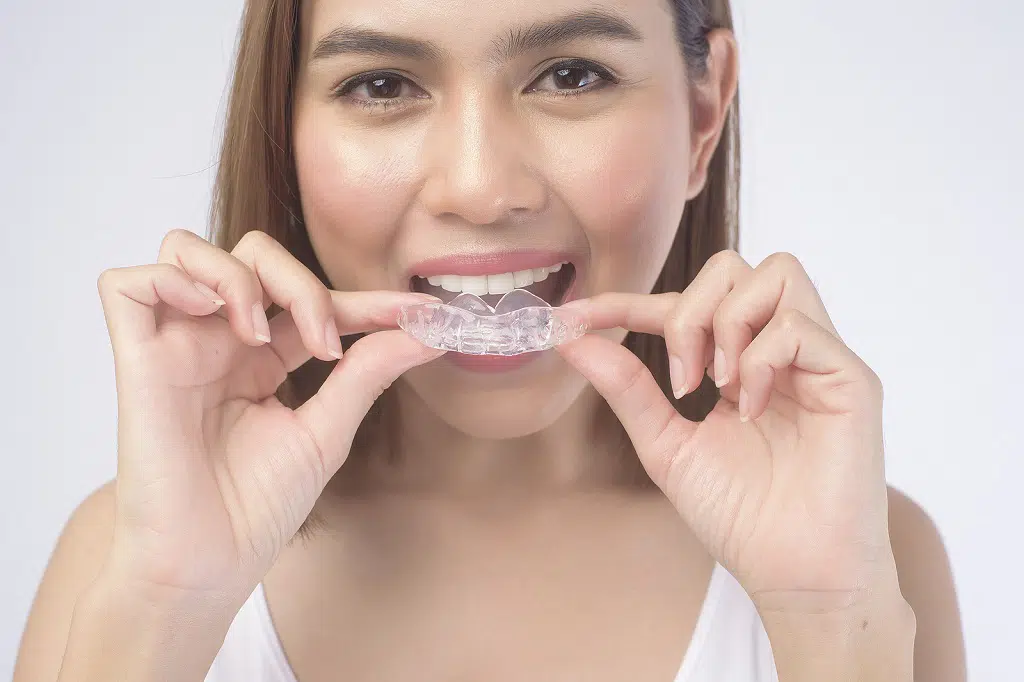

Invisalign offers a discreet alternative to braces, helping patients improve their teeth alignment with minimal disruption. Understanding how the treatment works can help you make an informed decision about your orthodontic care. Learn more about a step-by-step guide for Invisalign to keep you informed.
What Is Invisalign?
Invisalign is an orthodontic treatment that uses clear, removable aligners to gradually move teeth into proper positions. Each aligner is custom-made from a smooth, flexible thermoplastic material designed to fit over your teeth. Unlike traditional braces, the aligners contain no brackets or wires, which makes them nearly invisible when worn.
Who Is Invisalign For?
This treatment is suitable for teens and adults with mild to moderate orthodontic concerns. It can address many conditions, including crowded teeth, gaps, overbites, underbites, crossbites, and open bites. Patients who have previously worn braces and experienced some shifting of their teeth may also be good candidates.
More complex cases may still require traditional braces or additional procedures. Severe rotations, significant jaw discrepancies, or certain tooth movements can be difficult to correct with aligners alone. An evaluation by dental professional is a reliable way to determine whether Invisalign is right for you.
How Is Invisalign Applied?
Invisalign application begins with an initial consultation, during which your provider examines your teeth, reviews your dental history, and discusses your goals for treatment. Next, your provider captures a detailed record of your teeth. They may use a digital scanner to capture a three-dimensional model of your mouth. Using this model, your provider develops a customized treatment plan that maps out each stage of tooth movement and estimates treatment type and length.
Once your aligners are manufactured, you return to the office for fitting. In some cases, your provider will bond small, tooth-colored shapes called attachments to certain teeth. These attachments help the aligners grip the teeth more effectively and guide specific movements. Your provider will then confirm the fit of your first aligners and explain how to insert and remove them properly.
How Is Invisalign Cared For?
Proper care keeps your aligners clear, comfortable, and effective throughout treatment. It also protects your oral health, because bacteria trapped beneath unclean aligners can contribute to tooth decay and gum irritation. Following a consistent routine will help you achieve the results outlined in your treatment plan.
Consider the following maintenance and hygiene practices:
- Remove your aligners before eating or drinking anything other than plain water.
- Brush and floss your teeth before reinserting your aligners to avoid trapping food particles.
- Rinse your aligners each time you remove them to prevent buildup of saliva and plaque.
- Clean your aligners daily with a soft toothbrush and a clear, unscented soap or a cleaning product recommended by your provider.
- Avoid hot water, which can warp the material and compromise the fit.
- Store your aligners in their protective case whenever they are not in your mouth.
Attend all scheduled appointments and contact your provider promptly if an aligner cracks or no longer fits correctly. Your aligners need to be changed as your teeth alignment improves; consistency yields the best results.
Get Invisalign
Invisalign provides a discreet, comfortable, and effective way to straighten teeth for many patients. By understanding how the treatment works, your candidacy, the application process, and aligner care, you can know if this procedure will work for you. Schedule a consultation with your provider to discuss your goals and learn how a personalized treatment plan will benefit you.
